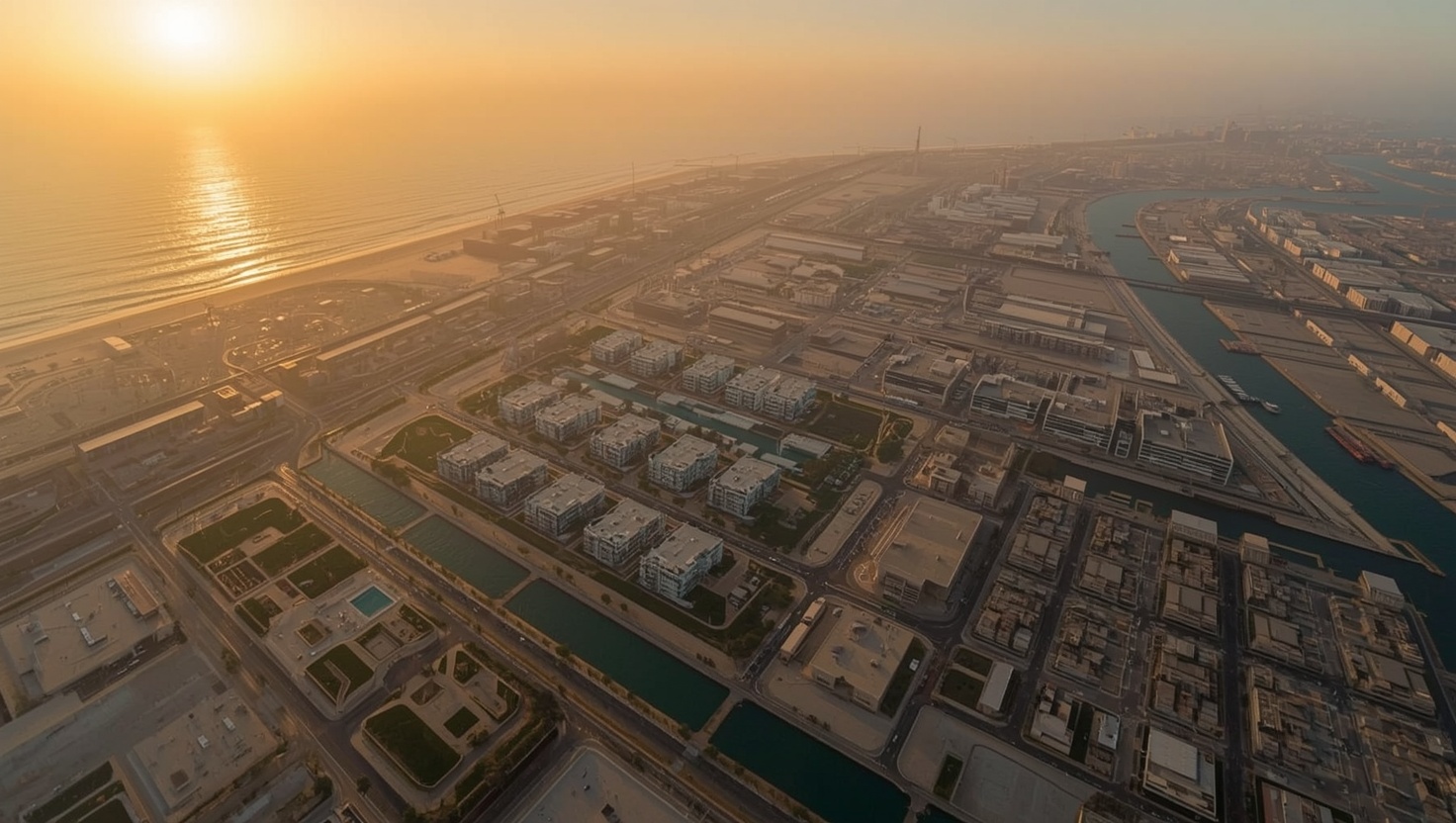
Saudi Arabia operates a sector-specific special economic zone (SEZ) model fundamentally different from the UAE’s high-volume free zone system. The Kingdom’s SEZs are designed to attract anchor industrial investments, not general commercial registrations. Four core SEZs — KAEC, Ras Al-Khair, Jazan, and Cloud Computing — received their final regulatory frameworks on 16 April 2026, with a 5 % corporate tax rate for up to 20 years and full exemption from Zakat. Last updated: May 2026.
For the broader GCC free zone landscape, see GCC free zones explained: complete guide for foreign founders. For the Saudi business setup context, see how to set up a business in the GCC: a complete guide for foreign founders.
How do Saudi SEZs differ from UAE free zones?
The UAE’s 45+ free zones are commercially standardised, high-throughput zones where thousands of businesses register at relatively low cost with minimal sector restrictions. Saudi Arabia’s SEZs are large-scale, sector-specific, and infrastructure-intensive — designed to anchor industrial supply chains rather than general commercial licences.
| Dimension | UAE free zones | Saudi SEZs |
|---|---|---|
| Number | 45+ | 4 core + SILZ + NEOM |
| Business model | High-volume commercial registrations | Anchor industrial investments |
| Sector restrictions | Minimal — most activities permitted | Sector-specific per zone |
| Corporate tax | 0 % on qualifying income (QFZP) | 5 % for 20 years |
| Zakat | N/A for foreign-owned entities | 0 % (full exemption in SEZs) |
| Withholding tax | Standard UAE rates apply | 0 % on profit transfers to foreign countries |
| Customs | Varies by zone | 0 % on capital equipment and inputs |
| Setup model | Self-service online portals | MISA + ECZA coordinated application |
| Typical company size | SME to mid-market | Large industrial to multinational |
| Regulatory authority | Individual free zone authorities | ECZA (Economic Cities and Special Zones Authority) |
What are the four core Saudi SEZs?
The Saudi Council of Ministers approved the implementing regulations for the four core SEZs through Cabinet Decision No. 468/1447, issued 30 December 2025 and published in the Official Gazette on 16 January 2026. The regulations came into force on 16 April 2026.
King Abdullah Economic City (KAEC)
KAEC is located on the Red Sea coast and functions as the Kingdom’s primary SEZ for advanced manufacturing, logistics, automotive, FMCG, and pharmaceutical production. King Abdullah Port — Saudi Arabia’s first privately operated port — provides direct access to African and European trade routes. KAEC is the most operationally ready Saudi SEZ in 2026, with established industrial land, utility connections, bonded warehousing, and a functioning supply-chain ecosystem.
Ras Al-Khair SEZ
Ras Al-Khair is positioned as a global hub for maritime industries, shipbuilding, offshore platforms, and marine support services. The Saudi government targets a USD 14 billion maritime industry through this zone. Ras Al-Khair’s regulatory framework includes sector-specific labour and environmental provisions.
Jazan SEZ
Jazan is located on Saudi Arabia’s south-western coast near the Yemeni border. The zone focuses on food processing, mining, downstream metal manufacturing, and chemical processing. Jazan’s deep-water port and proximity to African markets differentiate it from the other SEZs. A major SABIC industrial complex anchors the zone.
Cloud Computing and Information Technology SEZ
The Cloud Computing SEZ is headquartered in Riyadh and is the only Saudi SEZ without a central physical location. Businesses can build and operate data centres anywhere in the Kingdom under this zone’s regulatory framework. The zone targets data storage, AI processing, and digital services for international technology companies — with projected investments of USD 13 billion by 2030 across data and AI sectors.
What about SILZ and NEOM?
Two additional Saudi zones operate under separate frameworks:
SILZ (Saudi Integrated Logistics Zone) is located at King Khalid International Airport in Riyadh and has been operational since October 2022 — predating the 2026 regulatory frameworks. SILZ offers the most generous tax incentive of any Saudi zone: 0 % corporate tax for 50 years. The zone is administered by GACA (General Authority of Civil Aviation) and focuses on logistics, supply chain, and air-cargo operations.
NEOM is a USD 500 billion giga-project in north-western Saudi Arabia that operates as both a city and an investment zone. NEOM’s regulatory framework is distinct from the four core SEZs and includes bespoke incentive packages negotiated individually with anchor investors. NEOM’s current focus areas include hydrogen production, advanced materials, biotech, media, and tourism.
What are the SEZ tax and customs incentives?
| Incentive | Detail |
|---|---|
| Corporate tax | 5 % for up to 20 years (vs 20 % mainland) |
| Zakat | Full exemption for all SEZ entities |
| Withholding tax | 0 % on profit transfers to foreign countries |
| Customs duty on capital equipment | 0 % |
| Customs duty on inputs/raw materials | 0 % or deferred within SEZ |
| Foreign talent regulation | Supportive regulations for the initial 5 years |
| Companies Law exemption | SEZ entities are exempt from the standard Saudi Companies Law and Trade Names Law |
According to the KPMG Saudi tax insight published in April 2026, ZATCA is authorised to issue detailed procedural guidance on tax processes and Economic Substance Requirement compliance. The ESR regulations were released for public consultation in February–March 2026, with final versions expected shortly after the April activation date.
How do you set up in a Saudi SEZ?
The setup process for a Saudi SEZ differs from the self-service model in UAE free zones. Saudi SEZs require a coordinated application through MISA (Ministry of Investment) and ECZA:
- Engage with ECZA or the specific zone operator (KAEC Economic City, Jazan City for Basic Industries and Conversion, etc.)
- Submit a business plan and investment commitment aligned with the zone’s sector focus
- Receive MISA investment licence (Royal Decree M/19 framework)
- Register with the zone’s internal commercial register (exempt from standard Saudi Companies Law)
- Register with ZATCA for the 5 % SEZ tax rate
- Lease industrial land, warehouse, or office from the zone operator
The process is not designed for solo entrepreneurs or small service companies. Saudi SEZs target manufacturing firms, logistics operators, technology companies, and multinational anchor investors with substantial capital commitments.
Frequently asked questions
Can a small consulting firm set up in a Saudi SEZ?
Generally, no. Saudi SEZs are designed for industrial and capital-intensive operations. A consulting firm or digital-services company would register through MISA’s standard mainland investment licence framework rather than an SEZ. The UAE’s free zones remain the default for small and mid-market service companies entering the GCC.
When did the Saudi SEZ regulations come into force?
The implementing regulations for the four core SEZs (KAEC, Ras Al-Khair, Jazan, Cloud Computing) came into force on 16 April 2026, 90 days after publication in the Official Gazette on 16 January 2026, per Cabinet Decision No. 468/1447.
Is the 5 % SEZ rate better than the UAE’s 0 % QFZP rate?
For industrial and manufacturing businesses, the Saudi 5 % rate combined with 0 % customs, 0 % withholding tax, and full Zakat exemption can be more attractive than the UAE’s QFZP regime — particularly because QFZP conditions are stringent and failure triggers a 5-year lockout at 9 %. For services and holding structures, the UAE’s QFZP at 0 % remains more favourable.
Sources and further reading
- Cabinet Decision No. 468/1447 (30 December 2025) — Implementing regulations for four Saudi SEZs
- ECZA (Economic Cities and Special Zones Authority) — SEZ governance and zone selection
- Special Economic Zones Law (Royal Decree M/3 of 2023) — Legal framework for Saudi SEZs
- KPMG Saudi Arabia — SEZ regulatory framework analysis, April 2026 (kpmg.com/sa)
- SILZ (Saudi Integrated Logistics Zone) — Zone framework and 0 % CIT incentive
- ZATCA — SEZ tax registration and ESR compliance guidance (zatca.gov.sa)