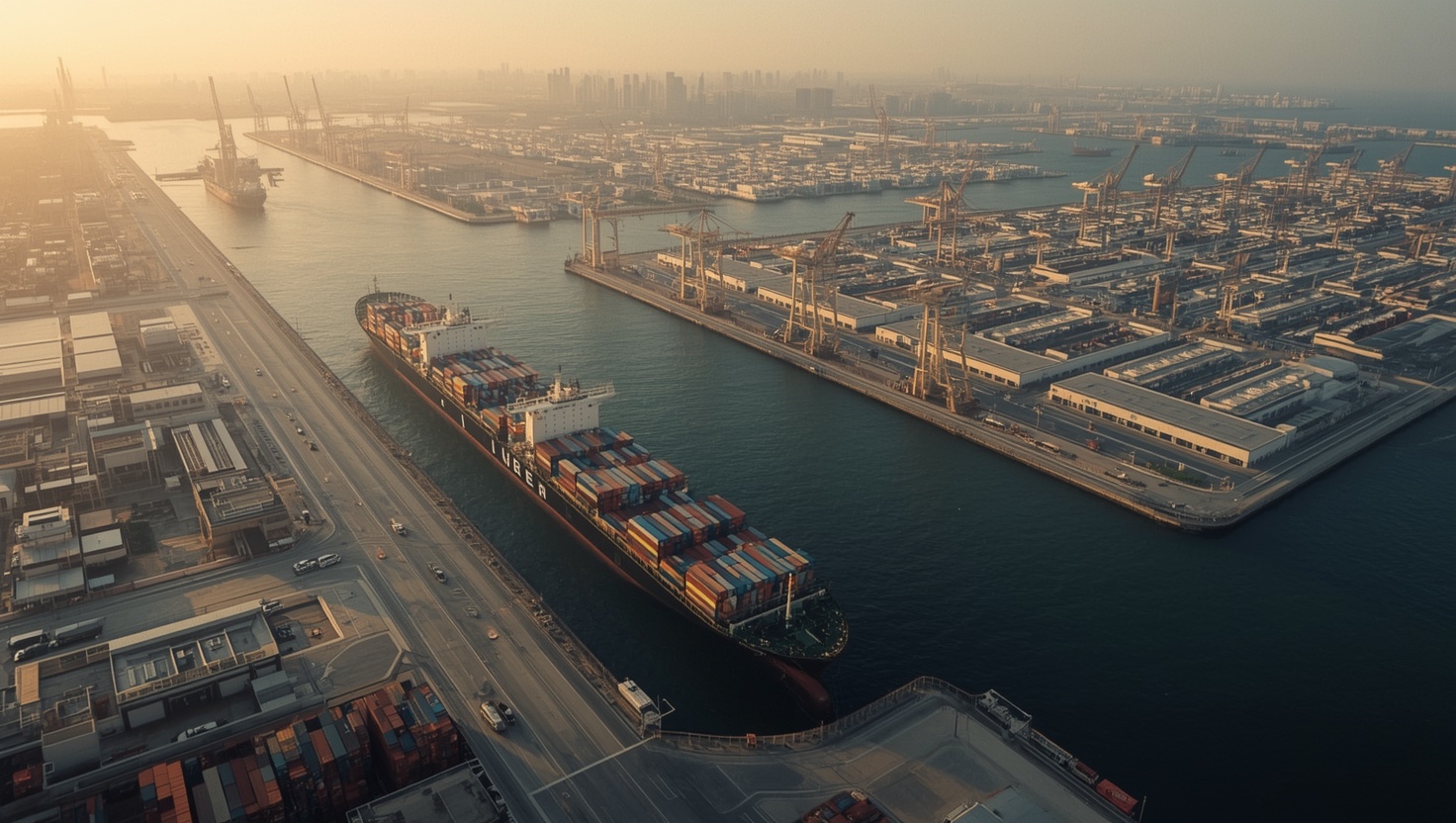
JAFZA is one of the world’s largest free zones and the UAE’s premier hub for logistics, trading, manufacturing, and import-export operations. Established in 1985 adjacent to Jebel Ali Port — the world’s 9th largest container port — JAFZA hosts over 9,000 companies from 100+ countries. A general trading licence costs approximately AED 30,000 per year, with total first-year setup between AED 40,000 and AED 55,000. Last updated: May 2026.
For the broader free zone comparison, see GCC free zones explained: complete guide for foreign founders. For the mainland alternative, see UAE mainland vs free zone: which is right for your business in 2026?.
Why do founders choose JAFZA?
JAFZA’s core advantage is port connectivity. Direct access to Jebel Ali Port means imported goods clear customs and arrive in a JAFZA warehouse without ever touching the mainland road network. Re-export to Africa, South Asia, and the wider Middle East routes through the port’s established shipping lines. Al Maktoum International Airport, adjacent to JAFZA, adds air-freight capacity.
Three structural differentiators:
- Physical infrastructure — warehouses from 200 sqm to industrial plots spanning thousands of square metres, cold storage, and hazardous-materials-certified facilities
- DP World backing — JAFZA operates under DP World, one of the world’s largest port operators, giving JAFZA companies access to integrated supply-chain solutions
- Offshore option — JAFZA offers an offshore company registration (AED 10,100 initial, AED 2,500 annual renewal) for international holding and asset-protection structures. See offshore company setup in the UAE: when and why for details.
What does JAFZA cost in 2026?
| Component | Range |
|---|---|
| Trading licence (annual) | AED 15,000 to AED 30,000 (general trading: AED 30,000) |
| Service licence (annual) | AED 10,000 to AED 20,000 |
| Industrial licence (annual) | AED 20,000 to AED 35,000 |
| Registration and name reservation | AED 2,000 to AED 5,000 |
| MOA attestation | AED 200 |
| Flexi-desk (annual) | AED 18,000 to AED 25,000 |
| Warehouse (annual) | AED 50,000 to AED 500,000+ (size-dependent) |
| Investor visa (per person, all-in) | AED 4,000 to AED 6,000 |
| Total first-year (trading, 1 visa, flexi-desk) | AED 40,000 to AED 55,000 |
JAFZA does not offer virtual-office-only setups. Every JAFZA company must lease a physical facility within the zone — flexi-desk, office, or warehouse. This raises the cost floor compared to zones like IFZA or Meydan that accept virtual addresses.
How fast is JAFZA setup?
JAFZA licence issuance takes 7 to 10 business days from application submission and payment. Full setup including visas and facility activation takes 6 to 8 weeks — slower than DMCC (3 to 5 days licence) but competitive for industrial-scale operations that require physical infrastructure.
Who should choose JAFZA — and who should not?
Choose JAFZA if:
- Your business imports, exports, or re-exports physical goods and needs direct port access
- You need warehouse or industrial-production facilities at scale
- You operate in supply chain, logistics, FMCG distribution, or commodity trading
- You want the credibility of a 40-year-old free zone backed by DP World
Do not choose JAFZA if:
- You are a solo consultant or digital-services company — DMCC, IFZA, or Meydan offer better value
- Budget is a priority — JAFZA’s physical-facility requirement sets a higher cost floor than virtual-office zones
- You need regulated financial-services licensing — DIFC and ADGM are purpose-built for finance
Frequently asked questions
Can JAFZA companies sell on the UAE mainland?
JAFZA companies can sell to mainland businesses under specific qualifying conditions, but direct B2C mainland sales are excluded. The standard pathway for dual access is a JAFZA parent plus a mainland subsidiary or distributor.
Does JAFZA qualify for 0 % corporate tax?
JAFZA is a Designated Free Zone. JAFZA entities can apply for QFZP status under the same conditions as other UAE free zones — qualifying activities, substance, audited financials, and the de minimis cap per Ministerial Decision No. 229 of 2025.
How does JAFZA compare to DMCC?
JAFZA is stronger for logistics, warehousing, and port-connected trading. DMCC is stronger for services, B2B consulting, commodity trading from an office, and banking ease. JAFZA’s physical-facility requirement makes it more expensive for light operations. DMCC’s JLT location offers lifestyle advantages.
Sources and further reading
- JAFZA — Official licensing, warehouse options, and offshore registration (jafza.ae)
- DP World — Jebel Ali Port infrastructure and trade-route connectivity (dpworld.com)
- Ministerial Decision No. 229 of 2025 — QFZP qualifying activities
- UAE Federal Tax Authority — Free zone tax treatment (tax.gov.ae)