
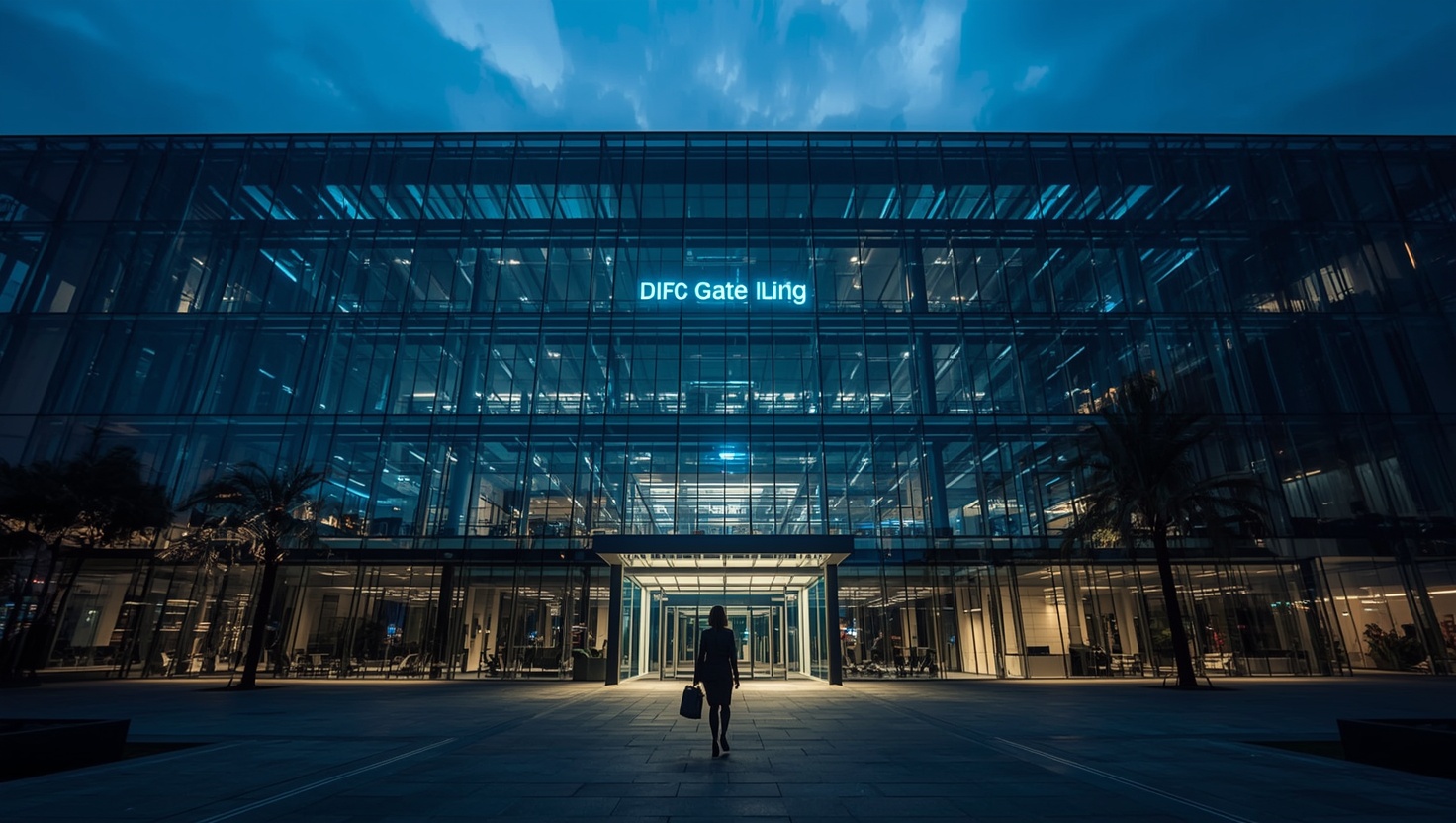
DIFC is the UAE’s premier financial free zone, operating under an independent English common-law framework regulated by the Dubai Financial Services Authority (DFSA). A standard non-regulated DIFC licence costs approximately USD 8,100 (AED 29,700) in registration and issuance fees, with first-year total costs starting at AED 65,000 for a small entity and exceeding AED 250,000 for a DFSA-regulated firm. DIFC hosts over 4,000 registered entities and manages assets exceeding USD 1 trillion. Last updated: May 2026.
For the broader free zone comparison, see GCC free zones explained: complete guide for foreign founders. For the UAE jurisdiction decision, see UAE mainland vs free zone: which is right for your business in 2026?.
Why do founders choose DIFC?
DIFC’s structural advantage is English common law under DFSA regulation. Contracts, disputes, and corporate governance follow common-law principles familiar to international investors, Western-trained lawyers, and institutional fund managers. The DIFC Courts operate independently of the UAE mainland courts, with judgments enforceable across 40+ jurisdictions through the Hague Convention and bilateral treaties.
Three differentiators:
- DFSA regulation — the only UAE financial regulator benchmarked to international standards (IOSCO, Basel III). Banks, fund managers, broker-dealers, insurance companies, and fintech firms operating under DFSA regulation carry global credibility.
- Asset under management (AUM) concentration — over USD 1 trillion managed through DIFC-registered entities, creating a natural ecosystem for wealth management, family offices, and institutional capital.
- Innovation Licence — a startup-focused licence at USD 1,500 per year (90 % off standard fees) for fintech, AI, and Web3 startups, with flexi-desks at the DIFC Innovation Hub from USD 250 per month and up to 4 visas per desk.
What does DIFC cost in 2026?
| Component | Non-regulated entity | DFSA-regulated entity |
|---|---|---|
| Application fee | USD 3,000 | USD 15,000 to USD 70,000 (category-dependent) |
| Licence issuance fee (Ltd company) | USD 5,100 | USD 5,100 plus regulatory fees |
| Flexi-desk / Innovation Hub | From USD 250/month (~AED 11,000/year) | Not applicable — dedicated office required |
| Dedicated office | From USD 80/sqft/year (~AED 100,000+ for small unit) | From USD 80/sqft/year |
| Investor visa (per person) | AED 4,500 to AED 6,000 | AED 4,500 to AED 6,000 |
| Total first-year (non-regulated, flexi-desk, 1 visa) | ~AED 65,000 to AED 85,000 | — |
| Total first-year (DFSA-regulated, small office) | — | AED 250,000 to AED 900,000+ |
The DIFC Innovation Licence brings the effective first-year cost to approximately AED 20,000 to AED 30,000 for qualifying fintech, AI, and Web3 startups — comparable to mid-tier free zones like DMCC, but with access to DIFC’s common-law framework and investor ecosystem.
What licence types does DIFC offer?
- Commercial licence — trading, professional services, consulting, advisory (non-regulated)
- Retail licence — restaurants, retail outlets within the DIFC district (non-regulated)
- DFSA-regulated licence — asset management, fund administration, broker-dealer, insurance, banking, investment advisory
- Innovation Licence — early-stage fintech, AI, blockchain, and insurtech startups
- Prescribed Company — holding entities with lighter substance requirements, used for family-office and asset-holding structures
- Special Purpose Company (SPC) — for securitisation, structured finance, and project-finance vehicles
DFSA-regulated firms must meet ongoing capital-adequacy, reporting, and governance requirements set out in the DFSA Rulebook. DFSA application fees range from USD 15,000 to USD 70,000 depending on the Category (1 through 4) and the scope of regulated activities. DFSA prudential amendments scheduled for 1 July 2026 will affect capital requirements for in-scope firms.
How fast is DIFC setup?
Non-regulated DIFC entities: 2 to 3 weeks from application to licence issuance. DFSA-regulated entities: 3 to 6 months, driven by the DFSA’s review of business plans, compliance frameworks, key-person due diligence, and capital-adequacy documentation.
Who should choose DIFC — and who should not?
Choose DIFC if:
- You operate in financial services, wealth management, fund administration, or institutional advisory
- You need English common-law contract enforcement and DFSA-regulated credibility
- You serve institutional or ultra-high-net-worth clients who expect DIFC positioning
- You are a fintech, AI, or Web3 startup and qualify for the Innovation Licence
Do not choose DIFC if:
- You are a standard trading or e-commerce company — DMCC or IFZA offer better value
- Budget is constrained below AED 65,000 for year one — DIFC’s premium positioning comes at a premium price
- You need warehouse or logistics infrastructure — JAFZA is purpose-built for physical goods
Frequently asked questions
Is DIFC a Qualifying Free Zone for 0 % corporate tax?
Yes. DIFC is a Designated Free Zone under the UAE Corporate Tax regime. DIFC entities can apply for QFZP status if they meet all six conditions under Ministerial Decision No. 229 of 2025. Non-regulated DIFC entities earning qualifying income can benefit from the 0 % rate; DFSA-regulated firms must assess whether their income qualifies under the activities and de minimis tests.
How does DIFC compare to ADGM?
Both operate under English common law with independent financial regulators (DFSA for DIFC, FSRA for ADGM). DIFC has the larger ecosystem and the higher profile for institutional finance. ADGM offers lower non-financial licence fees (USD 5,500 initial vs USD 8,100 at DIFC) and is emerging as the Abu Dhabi hub for crypto, fintech, and family offices. Both are valid for serious financial-services positioning.
Can a DIFC entity serve clients outside the UAE?
Yes. DIFC entities can serve international clients without restriction. DFSA-regulated firms can passport their licences to serve clients across the GCC and broader MENA region, subject to local regulatory requirements in each jurisdiction.
Sources and further reading
- DIFC Authority — Licensing, fee schedule, and Innovation Licence (difc.ae)
- Dubai Financial Services Authority (DFSA) — Rulebook, Fees module (FER), and Category definitions (dfsa.ae)
- DIFC Courts — Jurisdiction, enforcement, and Hague Convention recognition (difccourts.ae)
- Ministerial Decision No. 229 of 2025 — QFZP qualifying activities
- UAE Federal Tax Authority — DIFC tax treatment (tax.gov.ae)