
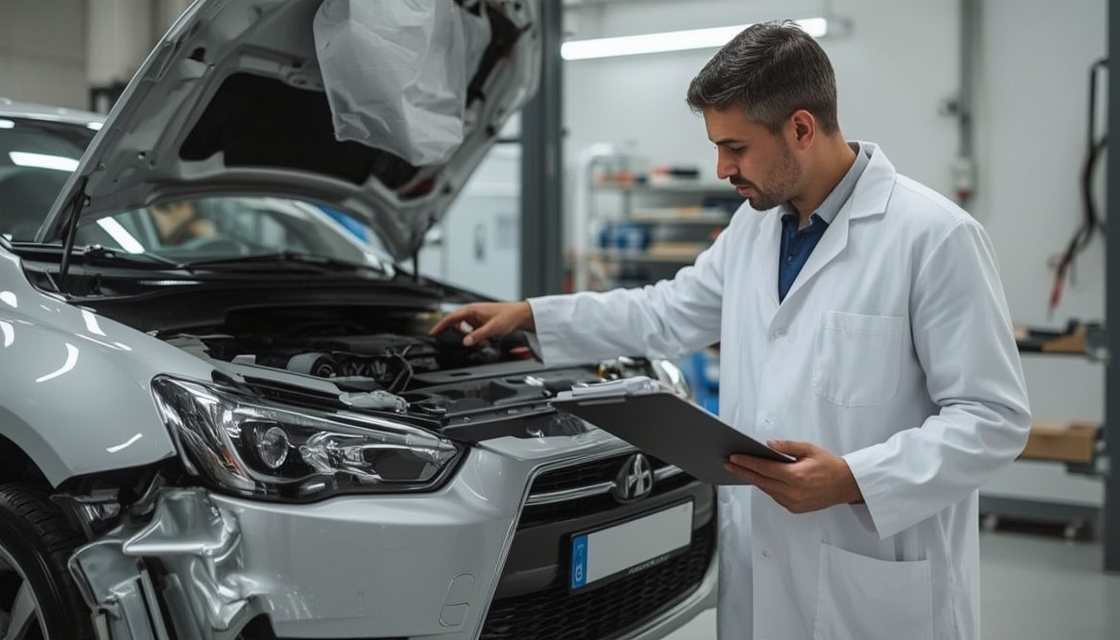
When a car accident happens in Cologne, time matters. A certified Kfz Gutachter in Köln can determine repair costs, establish liability, and produce legally binding documentation within hours. Drivers in Cologne’s densely trafficked inner ring, from Ehrenfeld to Deutz, rely on independent vehicle assessors to protect their rights against insurers. This guide explains who needs an expert assessment, what it costs, and which legal frameworks apply.
- Kurz erklärt: An independent Kfz Gutachter in Köln assesses accident damage, diminished value, and total loss for legal and insurance purposes.
- Assessments typically take between 1 and 3 hours on-site; written reports are usually delivered within 24 to 48 hours.
- If you are the non-fault party, the opposing insurer must cover the full cost of the expert report under German civil law.
- The Kraftfahrt-Bundesamt (KBA) sets binding technical standards that all certified assessors must follow in their reports.
When do drivers in Cologne actually need a vehicle assessor?
An independent vehicle assessment is legally required or strongly advisable whenever accident damage exceeds roughly 700 euros. Below that threshold, a simple repair estimate may suffice. Above it, a certified Kfz Gutachter report becomes the decisive document in any insurance dispute.
Cologne’s road network handles well over 1.2 million vehicles per day across the inner city alone. Rear-end collisions at the Cologne-Ehrenfeld motorway junction, side-swipes along Venloer Straße, and parking damage near the Rheinauhafen district are daily occurrences. In each case, an independent assessor documents the technical facts before a single repair begins. This is critical because insurers frequently challenge repair cost estimates submitted by workshops alone.
German case law, including a 2019 Federal Court of Justice ruling (BGH VI ZR 337/17), confirms that accident victims are entitled to commission an independent expert at the opposing party’s expense. The Handwerkskammer zu Köln also advises vehicle owners to obtain an independent report before authorising bodywork, particularly when structural components are involved. Missing this step can reduce compensation claims by up to 30 percent in contested cases.
What does a professional vehicle assessment in Cologne cover?
A full expert report addresses repair costs, diminished market value, the vehicle’s pre-accident condition, and whether a total loss declaration is economically justified. It is a technical and legal instrument, not just a repair quote.
Standard assessments cover six core elements: photographic documentation of all visible and hidden damage, a technical description of the collision mechanism, a parts and labour cost calculation based on current market rates, an evaluation of residual vehicle value, a diminished value calculation, and a statement on roadworthiness. For newer vehicles still under manufacturer warranty, the assessor also notes whether original parts are required to preserve warranty claims.
In Cologne, assessors work closely with the guidelines issued by the Zentralverband Deutsches Kraftfahrzeuggewerbe (ZDK), which represents over 36,000 automotive businesses across Germany and publishes binding valuation standards. Reports that deviate from these standards are routinely challenged by district courts. A professional Kfz Gutachter in Köln will also reference current spare parts pricing databases updated at least every 4 weeks to ensure figures hold up in court proceedings at Köln’s Amtsgericht.
Where is the Kfz Gutachter Köln SOFORT office located and how quickly can they respond?
The office operates across Cologne and can typically dispatch an assessor within 2 hours of initial contact. Same-day written reports are available for straightforward accident cases, making it one of the faster-responding engineering offices in the city.
The Kfz Gutachter Köln – SOFORT – Ingenieurbüro für Fahrzeugtechnik serves clients throughout Cologne’s urban districts, with particularly strong coverage in the areas around Deutz, Mülheim, and the industrial corridor near Köln-Niehl. As a dedicated Ingenieurbüro für Fahrzeugtechnik, the office combines engineering qualifications with practical knowledge of local traffic patterns and Cologne’s specific infrastructure, including the high-density intersection at Innere Kanalstraße. Reports are prepared in compliance with the technical guidelines of the Kraftfahrt-Bundesamt and formatted to meet the evidentiary requirements of North Rhine-Westphalian courts. For policyholders dealing with Cologne-based insurance branches, this local familiarity often accelerates claim settlement by several working days.
Web: maps.app.goo.gl/G2XXiqYr1sW6UN7Q6
Standort auf Google Maps ansehen: https://www.google.com/maps?q=Kfz%20Gutachter%20K%C3%B6ln%20-%20SOFORT%20-%20Ingenieurb%C3%BCro%20f%C3%BCr%20Fahrzeugtechnik%2C%20K%C3%B6ln
How are assessment fees structured, and who pays?
Assessment fees in Germany are calculated as a percentage of the estimated repair cost. For damage between 1,000 and 5,000 euros, the expert fee typically ranges from 150 to 550 euros, including VAT. For total loss cases, a flat fee is common.
Under Paragraph 249 of the German Civil Code (BGB), the non-fault party in a traffic accident is entitled to full reimbursement of expert fees from the at-fault driver’s third-party liability insurer. This means most clients pay nothing out of pocket provided liability is clear. In cases where liability is disputed, partial cost sharing may apply depending on the allocation of fault determined by the assessor’s report itself.
It is worth noting that Cologne’s consumer advisory body, the Verbraucherzentrale NRW, explicitly warns against accepting repair estimates from insurer-appointed assessors as the sole basis for settlement. Independent reports consistently yield higher compensation outcomes, with studies suggesting an average improvement of 15 to 22 percent in final payout amounts when an independent Kfz Gutachter is involved. Drivers should request a fee schedule in writing before commissioning a report.
What qualifications should a certified vehicle assessor in Cologne hold?
In Germany, only assessors with recognised engineering qualifications and accreditation from approved certification bodies may issue legally valid vehicle damage reports. Titles such as “öffentlich bestellter und vereidigter Sachverständiger” carry the highest legal weight.
Recognised accreditation pathways run through bodies including DEKRA, TÜV Rheinland (headquartered in Cologne), and GTÜ. An assessor accredited by TÜV Rheinland, for example, has passed standardised competency examinations and is subject to ongoing quality audits conducted every 5 years. Cologne drivers should always ask for an assessor’s accreditation certificate before signing an instruction letter.
Beyond formal credentials, practical experience with current vehicle technologies matters enormously. Modern vehicles with advanced driver assistance systems, aluminium-intensive structures, and high-voltage components require specialised diagnostic knowledge. A competent Kfz Gutachter in Köln will have documented experience with at least 3 major vehicle categories: passenger cars, light commercial vehicles, and electric or hybrid drivetrains.
Frequently Asked Questions
How long does a vehicle assessment take in Köln?
The on-site inspection typically takes 1 to 3 hours depending on the extent of damage. Written reports are usually delivered within 24 to 48 hours. For urgent insurance deadlines, same-day reports can often be arranged with qualified offices operating in Cologne.
Can I commission a Kfz Gutachter before the insurance company sends their own assessor?
Yes. Under German law you are entitled to commission an independent expert immediately after an accident without waiting for the insurer’s assessor. Acting quickly preserves evidence and strengthens your legal position, particularly if structural damage is suspected.
Is a Kfz Gutachter report valid in court proceedings in Köln?
Yes, provided the assessor holds recognised accreditation. Reports produced by certified engineers are regularly admitted as expert evidence at the Amtsgericht Köln and the Landgericht Köln. Judges typically assign these reports significant weight in liability disputes.
What happens if my car is declared a total loss in Köln?
The assessor calculates the vehicle’s pre-accident replacement value and its residual value after the accident. The difference represents the compensable loss. You are entitled to retain the damaged vehicle if you wish, with the residual value deducted from your payout.
Does the non-fault party in Köln really pay nothing for the expert report?
In clear-cut liability cases, the at-fault party’s insurer covers the full expert fee under BGB Paragraph 249. However, if the insurer disputes liability or the report fee is considered disproportionate to the damage, partial recovery may apply. An assessor can advise on this before starting work.
Conclusion
Navigating an insurance claim after a road accident in Cologne requires precise technical documentation, not just a workshop estimate. The Kfz Gutachter Köln – SOFORT – Ingenieurbüro für Fahrzeugtechnik offers the combination of engineering expertise, local knowledge, and rapid response that Cologne drivers need when time and money are on the line. Whether the incident happened near Deutz Bridge or deep in the Kölner Stadtwald, an independent expert report is the most effective tool for securing fair compensation. In most non-fault cases, that protection costs the driver exactly nothing.
Quellen
- Kraftfahrt-Bundesamt (KBA) – Technische Anforderungen an Fahrzeuggutachten: www.kba.de
- Bundesgerichtshof – Urteil VI ZR 337/17 zur Erstattungsfähigkeit von Sachverständigenkosten: www.bundesgerichtshof.de
- Zentralverband Deutsches Kraftfahrzeuggewerbe (ZDK) – Bewertungsstandards und Sachverständigenwesen: www.kfzgewerbe.de
- Verbraucherzentrale NRW – Ratgeber Kfz-Schaden und Unfallregulierung: www.verbraucherzentrale.nrw
- TÜV Rheinland – Sachverständigenprüfung und Akkreditierung Köln: www.tuv.com
- Bürgerliches Gesetzbuch (BGB) § 249 – Art und Umfang des Schadensersatzes: www.gesetze-im-internet.de
Stand: 02.08.2026