
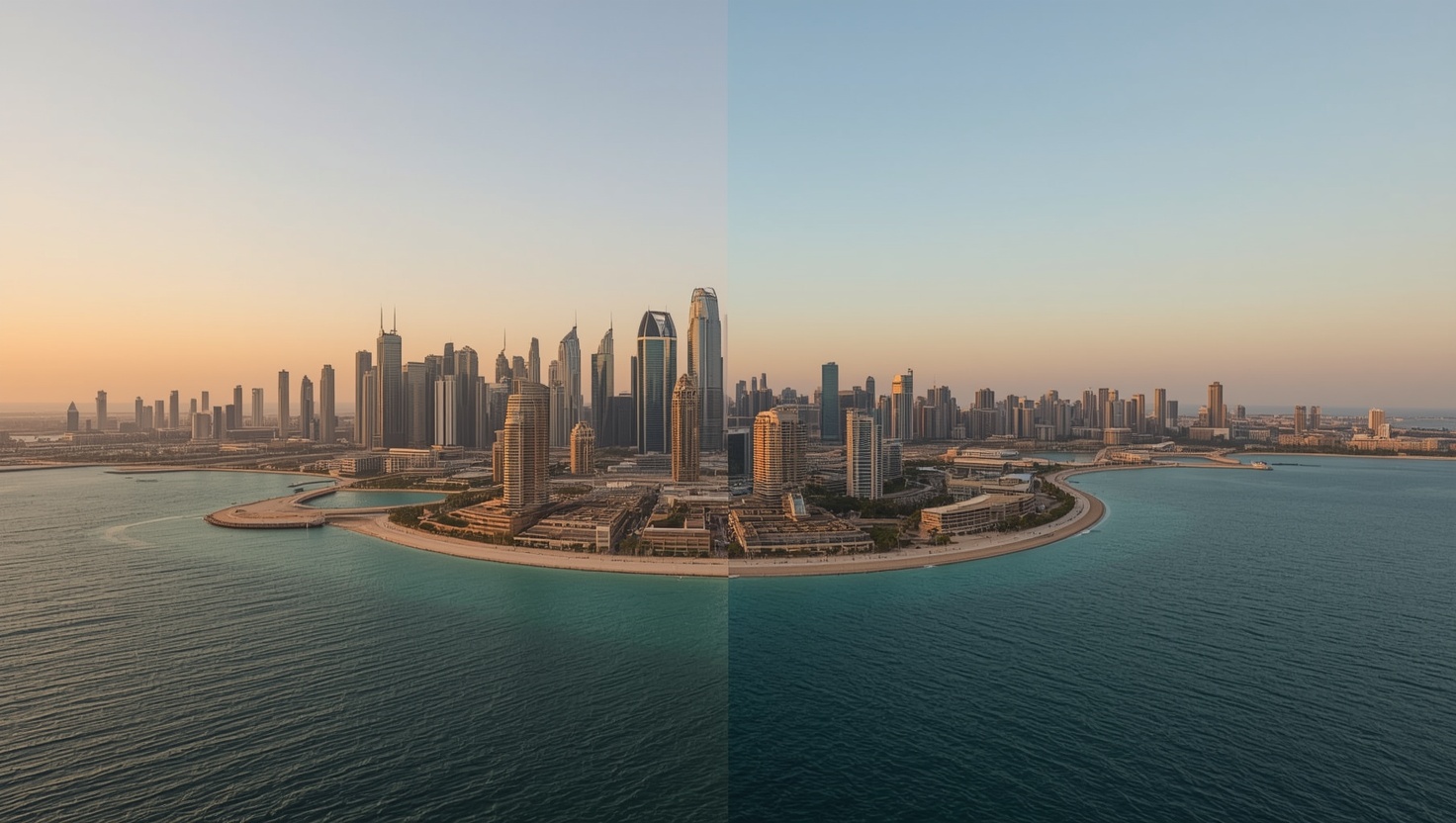
Dubai and Abu Dhabi sit ninety minutes apart on the same federal legal framework, share the same 9% corporate tax regime, and both offer 100% foreign ownership. Yet the two emirates have built very different business ecosystems, and choosing the wrong one can cost a founder time, capital, and access to the incentives that matter most for their sector. This guide compares setup routes, costs, free zones, tax, and sector fit so that founders can decide with evidence rather than reputation.
Dubai vs Abu Dhabi: Which Emirate Should You Choose?
Dubai suits trading, e-commerce, retail, logistics, and consumer brands that value speed, breadth of free zones, and a dense international market. Abu Dhabi suits finance, energy, deep technology, and government-facing businesses that benefit from sector grants, subsidised space, and proximity to sovereign capital.
Neither emirate is universally cheaper or better. Dubai’s advantage is breadth: dozens of competing free zones drive prices down and let founders launch in days. Abu Dhabi’s advantage is depth: it counters with targeted incentives, subsidised offices, and funding programmes for priority sectors (Noble Core Ventures, 2026). The right choice follows from what a business sells and who it sells to, not from headline setup fees, which land in broadly similar ranges across both emirates.
What Are the Free Zone Options in Dubai?
Dubai operates more than twenty free zones, each tuned to a sector, giving founders the widest menu in the UAE. The best-known are IFZA and Meydan for cost-efficient general trade, DMCC for commodities, and DAFZA for airport-linked logistics.
The International Free Zone Authority (IFZA) is the volume leader for small and medium enterprises, with base licences from around AED 12,900 and packages that carry up to six visas without a physical office. The Dubai Multi Commodities Centre (DMCC) is the flagship for trade in gold, diamonds, tea, and other commodities, and consistently ranks among the world’s leading free zones by company count. Meydan Free Zone offers a central Dubai address with flexi-desk packages from around AED 14,500, while the Dubai Airport Free Zone (DAFZA) serves aviation, pharmaceuticals, and re-export businesses that need runway proximity. This density means a founder can almost always find a zone whose licence categories, visa model, and address match their exact activity.
What Are the Free Zone Options in Abu Dhabi?
Abu Dhabi runs a smaller, more curated set of free zones built around the emirate’s strategic priorities: finance, media, industry, clean technology, and startups. The anchors are ADGM for financial services, KEZAD for industry and logistics, twofour54 for media, Masdar City for clean tech, and Hub71 for venture-backed startups.
Abu Dhabi Global Market (ADGM), on Al Maryah Island, operates under an independent common-law framework with its own courts and regulator, making it the natural home for funds, fintech, and wealth managers who want English-law contracts. KEZAD (the Khalifa Economic Zones Abu Dhabi) offers large industrial plots, warehousing, and logistics corridors linked to Khalifa Port. twofour54 provides media licences with production infrastructure, Masdar City hosts renewable-energy and sustainability firms, and Hub71 gives qualifying startups subsidised housing, office space, and access to the emirate’s sovereign-backed venture funds. The list is shorter than Dubai’s, but each zone comes with deeper sector infrastructure and, frequently, financial incentives attached.
How Much Does Business Setup Cost in Each Emirate?
Entry-level free zone packages in Dubai and Abu Dhabi fall into broadly similar AED ranges, so cost rarely decides the emirate on its own. A lean, zero-to-one-visa free zone company in either emirate typically starts between AED 12,500 and AED 20,000 in the first year.
The table below sets out indicative 2026 first-year ranges. Actual figures vary by activity, visa count, and office type, and founders should confirm current pricing with the specific authority before committing.
| Setup route | Dubai (AED, year 1) | Abu Dhabi (AED, year 1) |
|---|---|---|
| Free zone, no visa | from ~12,900 | from ~13,000 |
| Free zone + 1 investor visa | ~17,900–22,000 | ~18,000–24,000 |
| Mainland LLC (with office) | ~20,000–35,000+ | ~20,000–35,000+ |
| Sector incentive available | Rarely | Frequently (grants, subsidised space) |
Where Abu Dhabi diverges is on the incentive side. For priority sectors — finance, industry, clean tech, media — the emirate frequently offers grants, rent-free or subsidised offices, and funding that can offset or exceed the nominal setup cost. Dubai rarely matches this at the individual-company level, competing instead on the sheer breadth and price competition of its free zones.
Mainland or Free Zone: Which Structure Fits?
Free zones suit businesses that trade internationally, sell to other free zone entities, or provide services without needing to invoice the UAE domestic market directly. Mainland licences suit businesses that must trade freely inside the UAE, hold government contracts, or open physical retail across the emirates.
Since Federal Decree-Law 32/2021, amended by 20/2025, most mainland activities allow 100% foreign ownership without a local sponsor, closing the historic gap that once pushed foreigners into free zones by default. The practical trade-off in 2026 is market access versus overhead: a free zone company can sell into the UAE mainland only through a local distributor or by opening a mainland branch, while a mainland company can invoice any UAE customer directly but usually carries higher office and compliance costs. In both Dubai and Abu Dhabi, a growing number of founders run a hybrid — a free zone base with a mainland branch — to capture international tax positioning and domestic sales at once.
How Do Corporate Tax and Compliance Compare?
Corporate tax is identical in both emirates because it is a federal regime. The rate is 0% on taxable income up to AED 375,000 and 9% above that threshold under Federal Decree-Law 47/2022, collected by the Federal Tax Authority regardless of which emirate issues the licence.
Qualifying Free Zone Persons in either emirate can still access a 0% rate on qualifying income, provided they meet substance requirements and stay within the de minimis limits for non-qualifying revenue. VAT at 5% applies uniformly across the UAE. The compliance calendar — corporate tax registration, annual filing, and, from 2027, mandatory e-invoicing for businesses above AED 50 million in revenue — is set federally and does not change when a company crosses the emirate line. In short, tax and reporting obligations are a UAE-level decision, not a Dubai-versus-Abu-Dhabi one, which is why sector fit and incentives carry more weight in the choice.
Which Sectors Thrive in Dubai vs Abu Dhabi?
Dubai is strongest for trading, e-commerce, retail, consumer brands, logistics, hospitality, and professional services aimed at a global customer base. Abu Dhabi is strongest for financial services, energy, industrial manufacturing, deep technology, media production, and any venture seeking government contracts or sovereign investment.
A consumer-goods importer or an online retailer will find Dubai’s re-export infrastructure, port access, and consumer density hard to beat. A fintech or fund manager will find ADGM’s common-law regulator and Abu Dhabi’s capital ecosystem a better fit than a general Dubai trade licence. An industrial manufacturer weighing land cost and logistics will compare KEZAD’s plots against Dubai’s industrial zones, often finding Abu Dhabi more competitive on subsidised space. The sharpest way to decide is to ask where a company’s customers, regulators, and capital sit — the emirate that hosts all three is usually the right base. Media and content producers are a useful edge case: twofour54 in Abu Dhabi bundles production facilities and rebates that a general Dubai licence cannot match, yet Dubai Media City offers a denser commercial ecosystem for agencies chasing regional brand clients. The decision again turns on whether a firm sells to the market or draws on the emirate’s infrastructure and incentives.
How Do Funding and Incentives Differ Between the Emirates?
Abu Dhabi actively subsidises the businesses it wants, while Dubai lets market competition among free zones do the work. The result is that a funded startup or a strategic-sector firm can extract direct financial support in Abu Dhabi that has no Dubai equivalent, whereas a bootstrapped trader usually finds Dubai’s price competition more useful.
Hub71, Abu Dhabi’s flagship startup programme, illustrates the model: qualifying technology ventures can receive subsidised housing, free or discounted office space, and access to a network of sovereign-backed venture funds, in exchange for basing the company in the emirate. ADGM adds regulatory sandboxes for fintech, and the emirate’s industrial and clean-tech programmes routinely bundle land, utilities, and grant funding for anchor investors. Dubai’s answer is structural rather than discretionary — with dozens of free zones competing on price and turnaround, founders benefit from a market that continually pushes packages down and services up. A founder should therefore ask whether their business is the kind Abu Dhabi will pay to attract; if not, Dubai’s competitive breadth is usually the stronger lever.
What Are the Common Setup Mistakes to Avoid?
The most frequent error is picking an emirate by reputation rather than by where a company’s customers, regulator, and capital actually sit. A close second is treating free zone and mainland as interchangeable when domestic market access is at stake.
Founders drawn to Dubai’s brand sometimes license there and then discover their real customers are Abu Dhabi government entities that prefer local suppliers, forcing a costly second setup. Others choose a free zone for its low headline price, then find they cannot invoice UAE mainland clients without a distributor or branch, eroding the saving. A third recurring mistake is underestimating visa capacity: because quota is tied to package tier or office size, a company that hires faster than planned must upgrade mid-year. Confirming market access, invoicing rights, and visa quota in writing before paying prevents all three, and costs nothing but a few emails to the authority.
What Is the Setup Timeline and Process?
A free zone company in either emirate can be licensed in roughly three to ten working days once documents are ready, while a mainland company generally takes one to three weeks depending on activity approvals. The core steps are identical across both emirates.
The sequence runs: choose the activity and legal form, reserve a trade name, secure initial approval, sign the lease or flexi-desk agreement, submit incorporation documents, pay the licence fee, and collect the licence and establishment card. Residence visas follow — entry permit, status change, medical test, Emirates ID, and visa stamping — typically adding one to two weeks per person. Founders who prepare passports, a business plan, and proof of address in advance, and who confirm their visa quota in writing before paying, move through either emirate’s process with the fewest delays.
Verdict: Dubai or Abu Dhabi in 2026?
Choose Dubai for speed, free zone choice, and access to a global trading and consumer market; choose Abu Dhabi for finance, industry, clean tech, and any venture that can capture the emirate’s sector-specific grants and subsidised infrastructure. Because tax, ownership rules, and federal compliance are the same in both, the decision comes down to market access and incentives rather than cost.
For most SMEs and traders, Dubai’s breadth and price competition make it the default. For regulated finance, heavy industry, and funded startups, Abu Dhabi’s depth and incentives often justify the shorter menu. Founders unsure of their trajectory can start lean in a Dubai free zone and add an Abu Dhabi presence or a mainland branch later, keeping optionality open while the business proves its market.